Entry 17 · Colour
What a chart cannot tell you
Two paint chips that agree in the store and argue on set.
- Entry
- 17
- Section
- 04 Colour
- By
- Ines Waldram
- Read
- 2 min
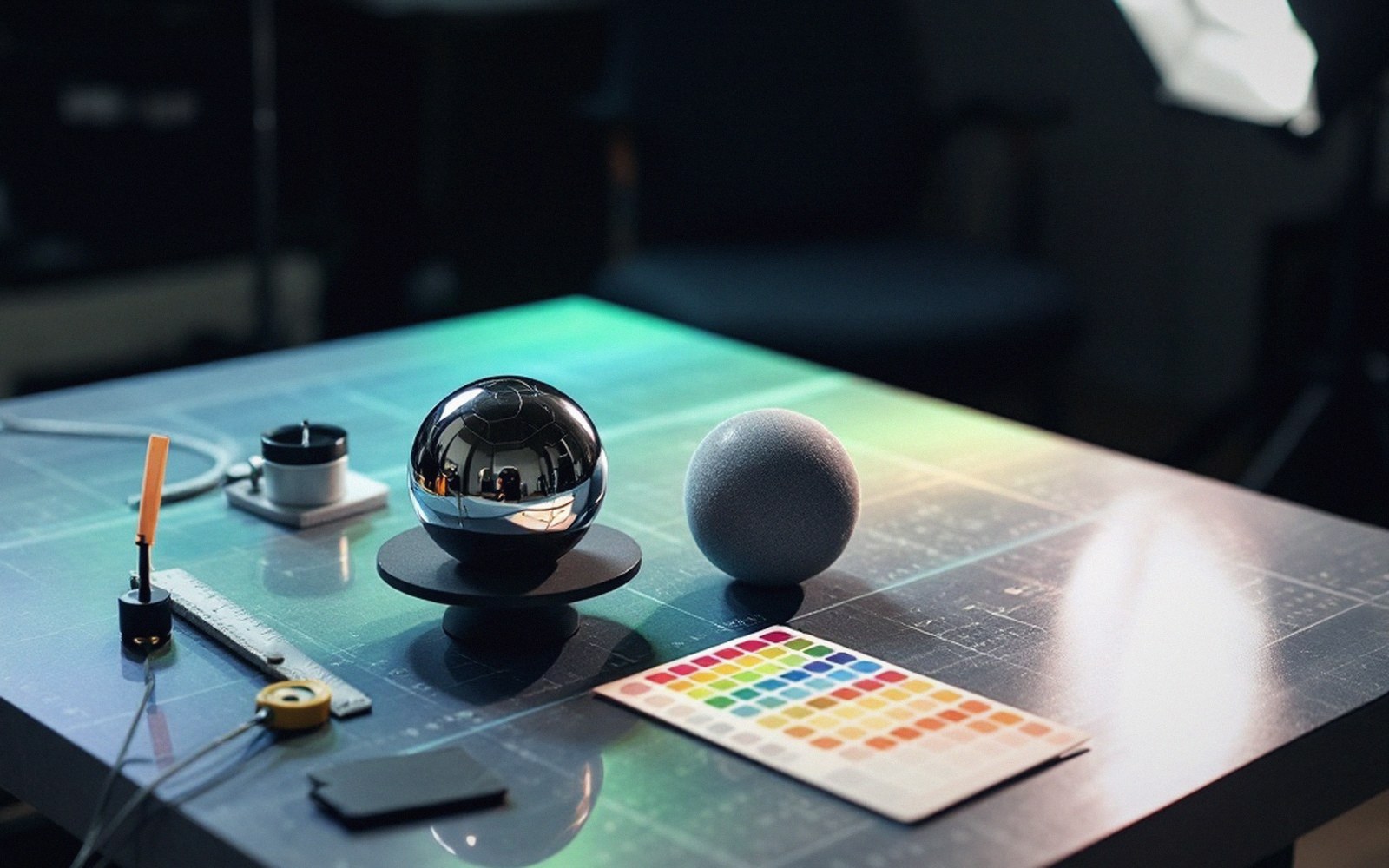
The match that moves
A colour chart does a lot. It anchors your colour pipeline, gives your colour-science tools something to chew on, and tells you whether your camera's response to a neutral patch is what you think it is. What it cannot do is guarantee that two surfaces which match under one light will match under another. That failure has a name: metamerism.
The physics is exact. Colour vision — and camera response — collapses a continuous spectral power distribution into three numbers: tristimulus values, one per cone type, or one per colour channel. Surfaces with completely different spectral reflectance profiles can produce identical tristimulus values under a given illuminant. Change the illuminant, and the spectra respond differently. The three numbers drift apart. The eye, or the sensor, sees a difference where it saw none before.
A colour chart tells you the tristimulus coordinates of its patches under the illuminant it was measured with, typically D50 or D65. It says nothing about whether your set paint, your costume fabric, and the chart patch you are trying to match are spectrally identical or merely metameric — coincidentally equal under that one light source. Warm tungsten on set, cool overcast through a window, an LED fixture with a spiked spectrum: any of these can break a match that looked solid on the chart.
LED sources make this acute. A broadband tungsten lamp has a smooth, continuous spectrum; most of the scene reflects it in proportion. A narrow-band LED packs energy into tight spikes. Two surfaces that happen to reflect those spikes equally can look matched — until you swap in a source whose spikes land somewhere slightly different. Stage and set departments know this intuitively as the problem of fluorescent costume under stage lighting; the spectral mismatch has just moved to a new generation of fixtures.
The practical consequence for image-making is not paranoia but awareness. When you shoot reference, shoot it under the actual lights that will illuminate the subject — not under whatever ambient happens to be convenient. If the chart and the surface are lit differently, you are measuring different things. When a compositor asks why the CG surface drifts from the plate in the warm shot but not the cool one, metamerism is the first hypothesis worth testing.
A chart anchors the known. The unknown is the spectral biography of every surface that was never measured. No amount of careful chart work closes that gap; only spectral measurement does, and most pipelines never get there. Until they do, the chart is necessary and the mismatch is always possible.

More in Colour
Every entry in this section is listed on the Colour page, and all twenty-four sit in the full register.