Entry 13 · Reference Objects
The grey ball
Direction, softness and colour of the key, read off a single object.
- Entry
- 13
- Section
- 03 Reference Objects
- By
- Ines Waldram
- Read
- 2 min
What the grey ball actually records
The chrome ball and the grey ball sit together on the reference stand, but they are answering different questions. The chrome ball is a mirror — it reflects everything, which makes it useful for recording the full panorama of light sources. The grey ball is a diffuser. It integrates incoming light across a hemisphere, weights it by the cosine of the angle of incidence, and shows you the result as a smoothly shaded surface.
That integration is exactly what a Lambertian surface does. So the grey ball is not showing you the light in the abstract — it is showing you the light as matte geometry will receive it. When you light a virtual character or a matte object against a photographed background, the grey ball is your contract with the real scene.
Three things are readable at a glance. First, direction: the brightest highlight on the ball points back at the dominant light source. It is broad rather than sharp, because a diffuse surface has no specular peak, but the bright lobe is still directional enough to tell you where the key is and at what elevation it sits. Second, softness: a hard source — bare HMI, direct sun — produces a clearly bounded terminator on the grey ball; an overcast sky or a large softbox wraps the shading around toward the shadow hemisphere with no sharp edge. Third, colour: the illuminated side carries the colour of the key, the shadow side picks up whatever fill or skylight is present. A warm evening key against a blue sky produces a warm-to-cool gradient that is metered directly off the ball rather than guessed at.
None of this requires extraction or conversion. You read it photographically. The grey ball earns its place precisely because it is so direct.
What to look for when matching
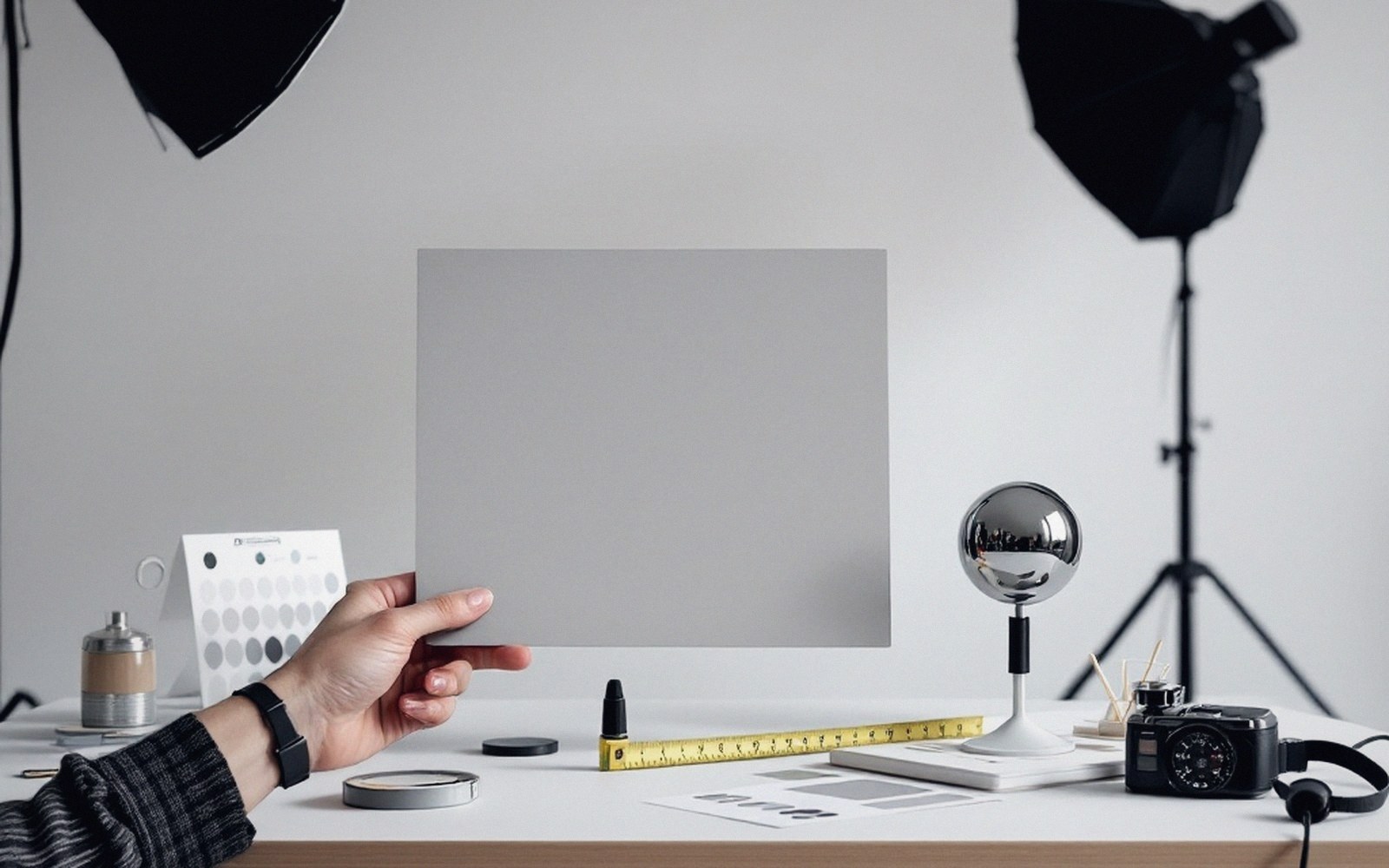
For visual effects and virtual production work, the grey ball photograph becomes a ground truth to match against. If a rendered sphere placed in the same scene position, with the same material, does not reproduce that shading gradient — the same terminator angle, the same colour ratio between lit and shadow side, the same apparent softness — then the lighting model is wrong, regardless of how plausible the result looks in isolation.
The grey ball is also honest about fill levels. Scenes that feel moody often have more fill than memory suggests; the ball quantifies it. When the two balls are shot together, the chrome records the full light map and the grey records the integrated effect — between them, you have both the source inventory and the scene-level consequence.
One practical note: the material matters. A sphere that is too dark loses detail in shadow; one that is too light clips in the highlights. A mid-grey — roughly 18 percent reflectance — gives the widest usable dynamic range on a single exposure.
That integration is exactly what a Lambertian surface does.
More in Reference Objects
Every entry in this section is listed on the Reference Objects page, and all twenty-four sit in the full register.